JIS D 0203 R1 R2 Rain Testing: Ensuring Automotive Part Durability
Need a JIS D 0203 R1/R2 rain test chamber? Request a quote within 24 hours.
Get technical specifications, customization options, and pricing from LIB Industry.
In the automotive industry, ensuring the durability and reliability of vehicle components is critical to maintaining safety, performance, and customer satisfaction. Rain exposure can cause water ingress, corrosion, electrical failures, and sealing problems in automotive components.
The JIS D 0203 R1/R2 rain test provides a controlled method for evaluating how automotive parts perform under simulated rainfall conditions. Using dedicated JIS D 0203 R1 R2 rain test equipment, manufacturers can reproduce defined water exposure conditions and identify potential weaknesses before products reach the market.
Understanding JIS D 0203 R1 and R2 Rain Testing
JIS D 0203 is a Japanese industrial standard used for environmental testing of automotive components. Its rain testing procedures help manufacturers evaluate resistance to water exposure under controlled laboratory conditions.
The two commonly referenced rainfall conditions are R1 and R2, which provide different levels of water exposure:
R1 Rain Test: Uses a lower water flow rate to simulate normal or moderate rainfall conditions. It can be used to evaluate components exposed to regular outdoor precipitation.
R2 Rain Test: Uses a higher water flow rate to create a more severe rainfall environment. It is suitable for components that may experience heavier rain and greater water exposure during vehicle operation.
LIB's current JIS D 0203 equipment configuration uses two Φ0.5 mm rain-nozzle holes, with water flow rates of 1.9 L/min for R1 and 3.3 L/min for R2. The specimen is positioned approximately 400 mm from the rain nozzle.
The purpose is not simply to spray water onto a component, but to create repeatable and controlled exposure conditions so engineers can compare designs, materials, seals, and manufacturing processes.
Why Is JIS D 0203 Rain Testing Important for Automotive Components?
Water ingress can create problems that may not appear during normal laboratory inspections.
For example, moisture entering a headlamp housing may cause condensation or electrical malfunction. Water entering a connector can reduce insulation performance or accelerate corrosion. Damaged door seals may allow water into the passenger compartment, while inadequate protection around electronic control units can lead to intermittent or permanent system failures.
Rain testing helps engineers identify these weaknesses during product development rather than after field deployment.
Typical automotive components that may require rain or water exposure testing include:
Headlights and tail lights
Exterior mirrors
Door seals and hinges
Automotive connectors
ECU and electrical enclosures
Sensors and cameras
Charging ports and EV components
Wiring and cable assemblies
Exterior electronic modules
For automotive suppliers, controlled rain testing can therefore support design validation, quality control, failure analysis, and product reliability improvement.
R1 vs. R2 Rain Testing: What Is the Difference?
The main difference between R1 and R2 is the intensity of water exposure.
| Test | Rain Nozzle | Water Flow Rate | Typical Purpose |
|---|---|---|---|
| R1 | 2 × Φ0.5 mm | 1.9 L/min | Moderate rainfall exposure |
| R2 | 2 × Φ0.5 mm | 3.3 L/min | Heavier rainfall exposure |
| S1 | 40 × Φ1.2 mm | 24.5 L/min | Higher-volume spray |
| S2 | 40 × Φ1.2 mm | 39.2 L/min | Severe spray exposure |
LIB's JIS D 0203 system can integrate both rain and spray configurations, allowing laboratories to evaluate different water exposure conditions using one test platform.
For engineers, this is particularly useful when the same automotive component needs to be evaluated under multiple environmental water conditions.
From Headlights to ECUs: Evaluating Automotive Water Ingress
Different automotive components have different water-ingress risks.
Exterior Lighting
Headlights and tail lights are directly exposed to rain, road splash, and temperature changes. Testing can help identify weaknesses around lenses, housings, gaskets, and cable interfaces.
Door Seals and Hinges
Door seals must maintain effective sealing performance over repeated exposure. Water testing can reveal leakage paths, poor compression, or inadequate sealing geometry.
Electrical Connectors and ECUs
Electronic components are particularly sensitive to moisture. Water penetration can result in corrosion, short circuits, insulation degradation, or unstable electrical performance.
EV and New Energy Components
As electric vehicles become more widespread, components such as charging interfaces, sensors, electronic modules, and battery-related enclosures require reliable protection against environmental water exposure.
For these applications, rain testing should be combined with the specific validation requirements of the component and vehicle manufacturer.
What Should You Look for in JIS D 0203 R1/R2 Rain Test Equipment?
Selecting a rain test chamber is not only about matching the test standard. The equipment should also provide stable water delivery, repeatable spray patterns, reliable control, and easy maintenance.
1. Accurate Water Flow Control
Stable flow is essential for repeatable R1 and R2 testing. LIB's equipment uses flow control and a water-pressure management system to maintain the required water delivery.
2. Correct Nozzle Configuration
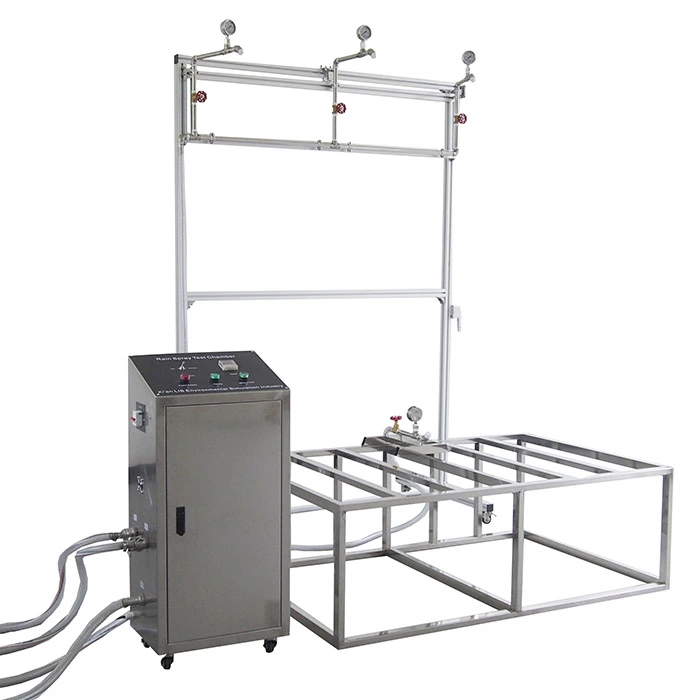
Nozzle diameter, quantity, position, and distance from the specimen directly influence the water exposure. The LIB R-1000JIS configuration uses two Φ0.5 mm rain-nozzle holes and a specimen-to-nozzle distance of approximately 400 mm.
3. Uniform Specimen Exposure
A rotating turntable helps expose different surfaces of the specimen to the simulated rainfall. The standard LIB configuration uses a rotation speed of approximately 17 r/min.
4. Water Filtration and Supply
Continuous water circulation can introduce particles that may clog small nozzles. A properly designed water tank, filtration or purification system, and automatic water supply help maintain stable test conditions.
5. Safety and Control
For laboratories testing electrically powered components, safety protection is especially important. LIB's chamber includes over-temperature, over-current, water-shortage, earth-leakage, and phase-sequence protection, together with an electromagnetic door-lock system.
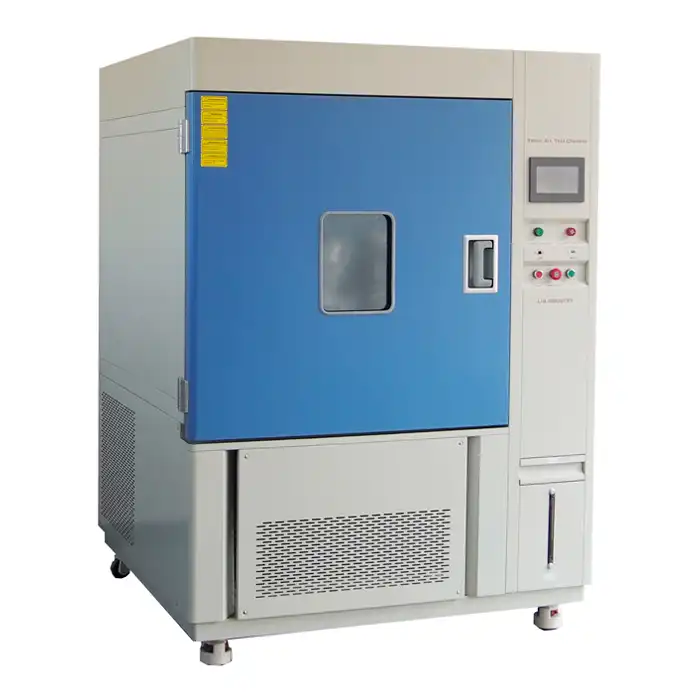
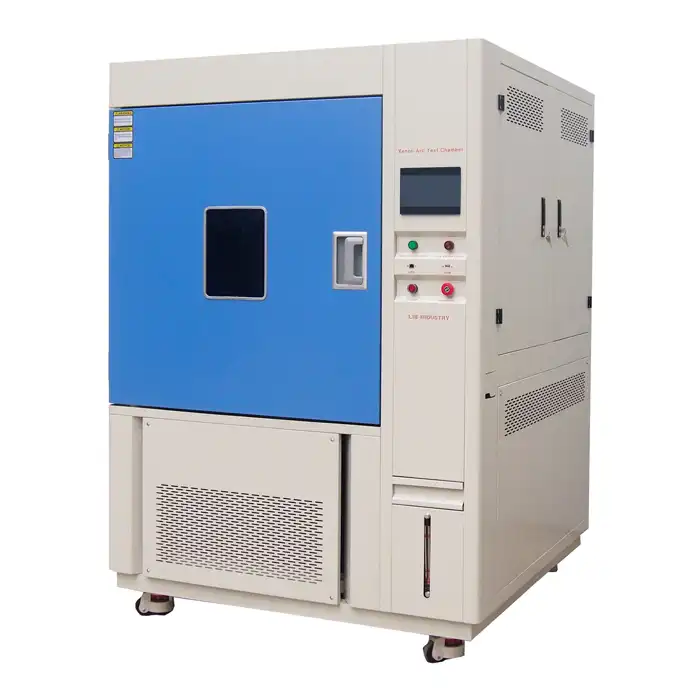
LIB Industry provides JIS D 0203 R1/R2 rain test equipment for automotive components, electrical assemblies, lamps, and enclosures.
Check specifications and request pricing →
LIB JIS D 0203 R1 R2 Rain Test Equipment
LIB Industry manufactures JIS D 0203 R1/R2 rain test equipment for automotive and industrial water-resistance testing. The R-1000JIS model provides a 1000 L internal test space, with larger capacities available for customized applications.
Key Technical Specifications
| Parameter | Specification | |
|---|---|---|
| Model | R-1000JIS |
|
| Internal Dimensions | 1000 × 1000 × 1000 mm | |
| Interior Volume | 1000 L | |
| Specimen-to-Nozzle Distance | Approx. 400 mm | |
| Rain Nozzle | 2 holes | |
| Rain Nozzle Hole | Φ0.5 mm | |
| R1 Water Flow Rate | 1.9 L/min | |
| R2 Water Flow Rate | 3.3 L/min | |
| Spray Nozzle | 40 holes | |
| Spray Nozzle Hole | Φ1.2 mm | |
| S1 Water Flow Rate | 24.5 L/min | |
| S2 Water Flow Rate | 39.2 L/min | |
| Water Pressure | 0.03–0.30 MPa | |
| Turntable Speed | 17 r/min | |
| Controller | Programmable color LCD touchscreen | |
| Communication | Ethernet, PC Link, USB | |
| Interior Material | SUS304 stainless steel | |
| Standard | JIS D0203 |
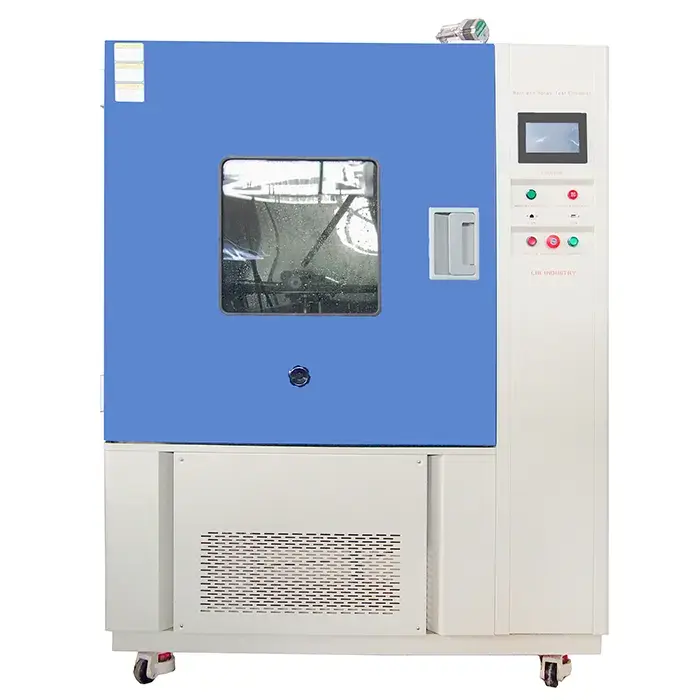
The chamber can also be configured for related water-ingress testing requirements. LIB's water spray product range includes solutions for IPX1–IPX6, JIS D 0203, MIL-STD-810 rain testing, and other customized water exposure applications.
Related Water Testing Equipment
If your automotive testing program covers more than JIS D 0203 R1/R2, LIB Industry can provide additional water testing solutions:
|
|
|
|
IPX5 IPX6 Rain Jet Test ChamberSuitable for evaluating resistance to powerful water jets according to applicable IP testing requirements. |
MIL-STD-810 Blowing Rain Test ChamberDesigned to simulate wind-driven rain conditions for products requiring military environmental testing. |
IPX7/IPX8 Water Immersion Test EquipmentUsed when the validation program requires temporary or continuous immersion testing in addition to rainfall exposure. |


These products can be linked together within a broader automotive environmental testing solution, allowing customers to build a more complete validation program instead of purchasing isolated test equipment.
Case Applications in Automotive Testing
Automotive manufacturers and suppliers can use JIS D 0203 rain testing during both product development and quality assurance.
For example, LED lighting assemblies can be tested under R2 conditions to identify potential water-ingress paths around the housing, lens, and cable interfaces. Door seals can also be evaluated to determine whether their sealing performance remains reliable under heavy rainfall exposure.
For electronic components, engineers can inspect the specimen after testing for visible water penetration, condensation, corrosion, insulation problems, or functional abnormalities.
The test results can then be used to improve gasket design, drainage structures, connector protection, housing geometry, and material selection.
FAQ
What is the difference between JIS D 0203 R1 and R2?
R1 uses a water flow rate of approximately 1.9 L/min, while R2 uses approximately 3.3 L/min in the LIB configuration. R2 therefore provides a higher level of rainfall exposure.
Can one chamber perform both R1 and R2 testing?
Yes. A properly configured JIS D 0203 rain test chamber can support both R1 and R2 conditions by controlling the corresponding water flow and test parameters.
Which automotive components can be tested?
Typical applications include headlights, tail lights, door seals, mirrors, connectors, ECUs, sensors, electrical enclosures, charging components, and other automotive assemblies exposed to rain.
Can the chamber be customized?
Yes. LIB Industry provides customized environmental test chambers based on specimen dimensions, test requirements, chamber capacity, nozzle configuration, control systems, and laboratory layout.
Can JIS D 0203 equipment perform other water tests?
Depending on the configuration, the same platform can integrate additional spray systems for S1/S2 and related water-ingress testing. LIB also provides dedicated IPX and military rain-testing equipment for broader validation requirements.
Request a JIS D 0203 R1/R2 Rain Test Solution
Reliable rain testing helps automotive manufacturers identify water-ingress risks before they become field failures. With controlled water flow, calibrated nozzles, stable specimen exposure, and programmable operation, JIS D 0203 R1/R2 rain test equipment provides a practical solution for automotive component durability testing.
LIB Industry manufactures standard and customized rain test chambers for automotive, electronics, lighting, EV, and industrial applications.
Need a JIS D 0203 R1/R2 rain test chamber?
Contact LIB Industry for technical specifications, customization options, and a quotation within 24 hours.
Email: ellen@lib-industry.com
3-Year Warranty & Lifetime Service