ASTM G154 UV Test Chamber Performance: Irradiance Uniformity and Lamp Stability
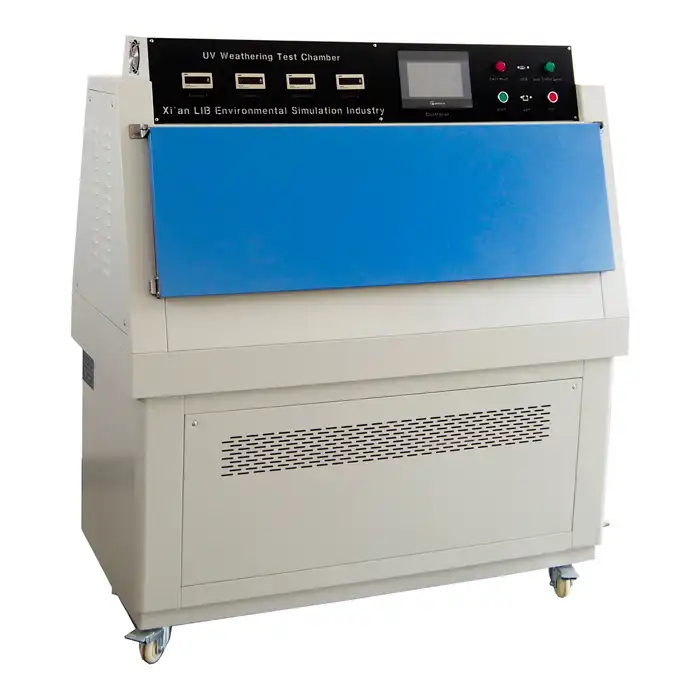
Quick answer: Irradiance uniformity and lamp stability decide whether an ASTM G154 UV test chamber produces data a lab can defend. Uniformity means every specimen position receives nearly the same UV dose. Stability means lamp output stays steady as tubes age. When either slips, identical samples degrade at different rates and run-to-run comparisons lose meaning. Closed-loop irradiance control, planned lamp replacement, a mapped rack and documented acceptance checks keep both under control. The LIB UV-SI-260 combines eight 40 W lamps, 0.3–20 W/m² irradiance control and a lamp-hours display for this purpose.
Why does irradiance uniformity matter for ASTM G154 results?
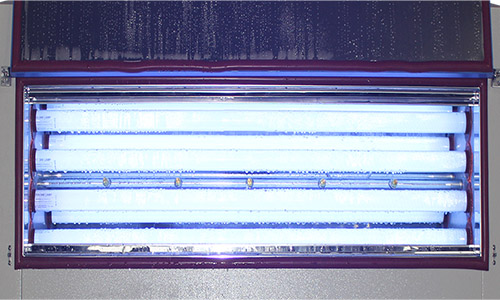
Photodegradation scales with UV dose, so a specimen in a dim position ages later than its neighbor. A fluorescent UV test chamber is a box of eight long tubes, and no layout delivers perfectly equal light to every inch of the rack. A formulation can therefore look better or worse purely because of where it sat.
Positions near the rack ends and outer rows often see different irradiance than the center, because tube ends emit less and wall reflections vary. Knowing this pattern tells you where replicates and controls belong. ASTM G154 describes the apparatus and exposure conditions, and ASTM G151 sets general requirements for laboratory light-source devices. Check the uniformity wording in the edition your contract cites.
How does lamp output decline, and why does it matter?
Fluorescent UV lamps lose output gradually and unevenly, so a UV test chamber without compensation delivers less UV than its setpoint. Phosphor wear and electrode aging reduce output over operating hours. A single weak tube creates a dim zone.
Lamp life: it depends on operating conditions. The UV-SI-260 lamps have a usable time of 5000 hours, after which they should be replaced.
Replacement: replace lamps as a set and rotate positions on a schedule, following the standard and the manufacturer's guidance.
Spectrum: mixing lamp types or ages in one run changes the spectrum as well as intensity. Record lamp type, installation date and hours for every program.
| Lamp | Behavior | Typical use |
|---|---|---|
| UVA-340 | Short-UV end of sunlight, peak near 340 nm | Outdoor coatings and plastics |
| UVA-351 | Sunlight filtered through window glass | Indoor products behind glass (check your equipment supports it) |
| UVB-313 | Harsher, peak near 313 nm, includes wavelengths not found in sunlight | Fast screening, not approval |
 |
 |
How does closed-loop irradiance control work?
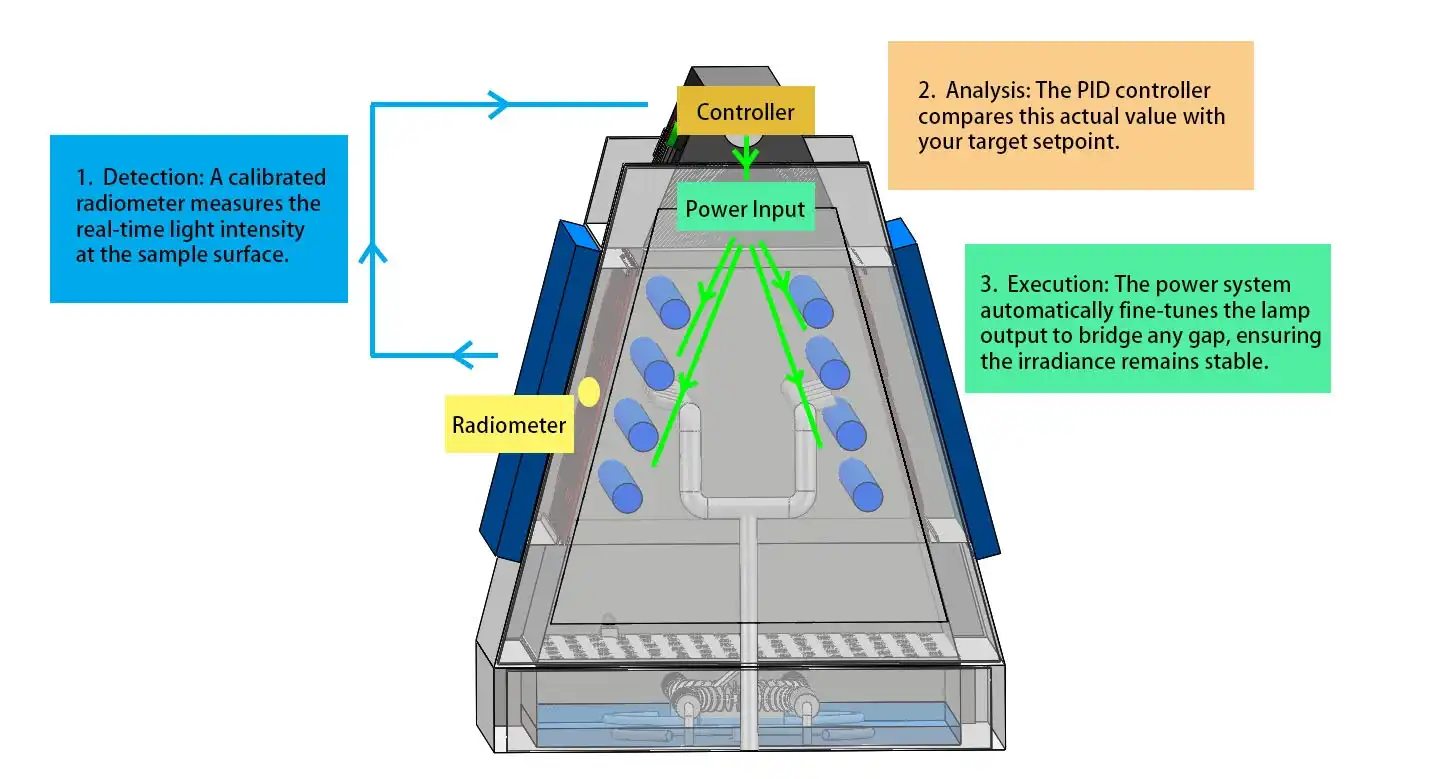
A UV sensor reads irradiance at the specimen plane, and the controller adjusts lamp power to hold the setpoint. This is the main defense against lamp aging.
Range: the UV-SI-260 offers irradiance control from 0.3 to 20 W/m² on a programmable color touch-screen controller. A wide range matters because different cycles and lamp types call for different setpoints.
Sensor calibration: a control loop is only as trustworthy as its sensor. Ask how often it needs calibration, whether a certificate is provided and how traceability is documented. A drifting sensor can hide a dim UV test chamber.
Control headroom: every lamp has a power ceiling. When aged lamps cannot reach the setpoint even at full power, the controller should alarm rather than continue silently.
What about temperature and moisture across the rack?
Uniform light means little if temperature and moisture vary from side to side. ASTM G154 cycles alternate UV exposure at a controlled black panel temperature with moisture phases.
Black panel temperature: the UV-SI-260 controls it from 35 to 80 °C using a 150 × 70 mm stainless steel black panel thermometer. Temperature differences across the rack change reaction rates, so readings should be consistent from side to side.
Moisture: the UV-SI-260 reaches ≥ 95% RH and offers a water spray cycle from 1 to 9999 h 59 min, with automatic water supply and purification. Patchy wetting under-stresses some specimens, so check wetting across the full rack. [Confirm how the UV-SI-260 produces the G154 moisture phase.]
Transition speed: how quickly the unit moves between UV and moisture stages affects the true duration of each condition. Ask for measured transition behavior, not just programmed times.
How do you map irradiance across the sample rack?
Mapping turns uniformity from a claim into a measured fact. Place a calibrated radiometer at a grid of positions across the specimen plane, at the same 50 mm lamp distance used for testing, and log the reading at each location. The result shows high and low zones.
Use the map in daily work: put critical specimens and controls in the most uniform area, spread replicates across zones, and reposition specimens periodically. The UV-SI-260 rack holds 56 specimens of 75 × 150 mm, so a mapped layout helps allocate positions sensibly.
| Mapping item | Practice |
|---|---|
| Measurement plane | Specimen surface at test distance |
| Instrument | Calibrated UV radiometer |
| Frequency | After lamp changes, maintenance or relocation, or when control charts show a trend |
| Record | Dated map filed in the equipment log |
What should you check before accepting a UV test chamber?
Agree acceptance checks in the purchase contract, not after delivery.
Empty-run verification: record temperature, black panel temperature, humidity and irradiance at several positions at agreed setpoints, and compare with datasheet tolerances (the UV-SI-260 chamber temperature accuracy is ±2 °C).
Full cycle: program an ASTM G154-style cycle and confirm that UV, moisture, spray and dark phases run in the right order, with automatic water supply working unattended.
Alarms and data: trigger alarm conditions deliberately and confirm they register, then check that exported records contain what an auditor would ask for.
Request documents rather than brochure phrases such as "uniform irradiance":
| Document | Why it matters |
|---|---|
| Sensor calibration certificate | Traceability of irradiance and temperature readings |
| Factory inspection report | Evidence of tested performance |
| Lamp specification and expected life | Basis for replacement planning |
| Controller program list | Confirms storage of required cycles |
| Mapping data and tolerance, with method | A number is meaningless without the measurement method |
| Warranty and spare-part terms | Predicts uptime |
LIB Industry UV-SI-260: a UV test chamber built for stable ASTM G154-style exposure
The UV-SI-260 runs UV light, temperature, humidity and water spray in one program, and its lamp display helps you replace lamps on time so exposure stays consistent between tests. [Confirm: designed for fluorescent UV exposure of the kind described in ASTM G154.]
| Parameter | UV-SI-260 |
|---|---|
| Light source | 8 × 40 W fluorescent UV lamps (UVA-340 or UVB-313), 50 mm from specimens |
| Wavelength / irradiance | 290–400 nm / 0.3–20 W/m² |
| Chamber / black panel temperature | Ambient to 90 °C ±2 °C / 35–80 °C |
| Humidity | ≥ 95% RH |
| Water spray cycle | 1–9999 h 59 min, adjustable |
| Specimen holder / capacity | 75 × 150 mm / 56 pcs, special holders can be customized |
| Controller | Programmable color LCD touch screen, Ethernet, PC link, multilingual |
| Water supply | Automatic, with water purification |
| Safety | Over-temperature, over-current, water shortage, earth leakage, phase sequence |
| Size / materials | 450 × 1170 × 500 mm interior; SUS304 stainless steel interior |
Features that support stability:
Lamp display: shows lamp service life, so replacement is planned, not discovered after results drift.
Closed-loop irradiance: 0.3–20 W/m², adjustable for UVA-340 or UVB-313 programs.
Stainless black panel thermometer: measures sample-plane temperature, adjustable from 35 to 80 °C.
Four conditions in one program: UV, temperature up to 90 °C, humidity ≥ 95% RH and spray run in a single sequence.
Multilingual control: German, French, Russian, Spanish, Portuguese, Polish, Turkish, Korean and more, with Ethernet to your PC.
Program storage and records: up to 120 programs of 100 steps, remote control and USB export [confirm], suited to G154, ASTM D4329 and ISO 4892 profiles plus custom cycles.
For full-spectrum sunlight, see the LIB Xenon Chamber.
Case study: UV-SI-260 at Premier Products, Thailand
A Thai manufacturer reports that its LIB UV-SI-260 continues to meet its testing requirements. In September 2026, the R&D department of Premier Products Public Co., Ltd. in Thailand followed up with LIB after delivery and confirmed in writing that the UV weathering test chamber (model UV-SI-260) is operating well and continues to meet its requirements. The customer also thanked LIB for its after-sales service and said it looks forward to working with LIB in the future.
Why buy from LIB Industry?
Tested before shipment: every unit runs 72 hours at the factory.
Certified and inspected: CE, RoHS, ISO 9001 and ISO 17025 calibration, with inspection by SGS and TÜV.
3-year (36-month) warranty: if a unit cannot be repaired within the warranty period, we replace it with a new one. Lifetime technical support afterwards.
Global service: local support in the US, UK, Canada and Malaysia, with 24/7 English remote support, plus installation and operator training.
Fast delivery: standard models ship within 7–15 days by sea, air or door-to-door.
Not sure how your lab should verify uniformity? Send your material, standard and test conditions, and our engineers will recommend a configuration.
FAQ
Why does irradiance uniformity matter in ASTM G154 testing?
Degradation scales with UV dose, so specimens in dim zones age more slowly. Poor uniformity makes identical samples behave differently and weakens comparisons between formulations or runs.
How often should UV lamps be replaced?
Follow the standard and the manufacturer's guidance. Lamp life depends on operating conditions (UV-SI-260 lamps have a usable time of 5000 hours), so track operating hours, rotate lamp positions and replace lamps as a set.
How can I check irradiance across the rack?
Use a calibrated UV radiometer at a grid of positions on the specimen plane. File the dated map and repeat it after lamp changes, maintenance or relocation.
Can I mix lamp types or lamp ages in one run?
No. Mixing changes the spectrum and intensity together, so results cannot be compared. Use one lamp type and replace lamps as a set.
What should be in a UV test chamber acceptance test?
An empty-run verification at agreed setpoints, a full ASTM G154-style cycle, alarm tests and a data export check, all agreed in the purchase contract.
Contact LIB Industry
LIB Industry is an ASTM G154 UV test chamber manufacturer providing turn-key environmental testing solutions, from design through installation and training. Send your material, standard and test conditions to ellen@lib-industry.com for a tailored quote within 24 hours.