How Thermal Shock Test Chambers Detect Material Failure Risks?
Thermal shock test chambers detect material failure risks by exposing specimens to abrupt temperature transitions - typically cycling between extremes such as -70°C and +200°C within minutes. When a material moves rapidly from a cold zone to a hot zone (or vice versa), it undergoes sudden volumetric changes. These transitions generate internal stresses that expose latent defects: micro-cracks propagate, adhesive bonds delaminate, solder joints fracture, and composite layers separate. By replicating real-world thermal cycling far faster than natural environmental conditions, the chamber accelerates degradation mechanisms that would otherwise take months or years to manifest. Engineers analyze specimens post-test using microscopy, electrical resistance measurement, and mechanical load testing to quantify structural integrity loss and predict service-life reliability.
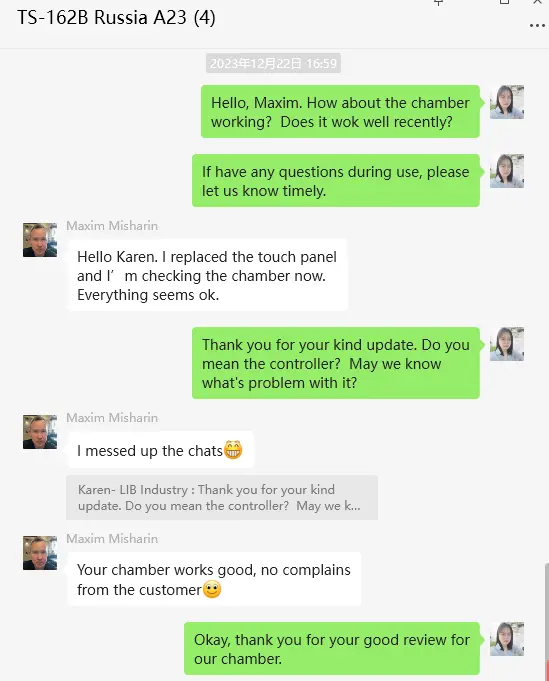
A client in Russia recently used our thermal shock test chamber for evaluating aerospace components. They reported that the chamber consistently cycled samples between -70°C and +200°C, revealing subtle material weaknesses that traditional testing had missed. The accelerated thermal transitions helped them identify potential failures early, improving product safety and reducing long-term warranty risks. They also noted that the chamber has been operating smoothly with minimal maintenance, providing highly reliable and reproducible test results that have become an essential part of their quality assurance process.
What Causes Material Failure During Rapid Temperature Changes?
Materials are not monolithic. Every component - polymer matrix, metallic conductor, ceramic substrate, adhesive layer - responds to temperature at its own rate and magnitude. When those rates diverge under sudden thermal loading, the result is mechanical conflict at the interface.
Differential Thermal Expansion
Every solid expands when heated and contracts when cooled. The coefficient of thermal expansion (CTE) quantifies this behavior per unit temperature change. In composite assemblies, two bonded materials with mismatched CTEs will strain against each other during rapid transitions. This mismatch stress concentrates at interfaces, initiating fatigue cracks that accumulate over repeated cycles.
Thermal Fatigue Accumulation
A single thermal shock cycle rarely causes catastrophic failure. Damage is cumulative: each pass through a temperature transition deposits a small increment of plastic deformation or micro-crack growth. Over hundreds of cycles - simulated within days in a test chamber - the cumulative damage reaches the critical threshold that triggers macroscopic fracture.
Phase Transformations and Brittleness
Some polymers undergo glass-transition shifts near operating extremes, becoming brittle at sub-zero temperatures. Solder alloys experience phase changes that alter grain structure under repeated thermal cycling. Identifying these transformation-driven failure modes early is critical to redesigning materials before a product reaches the field.
|
Failure Mechanism |
Typical Materials Affected |
Detection Method |
|
CTE mismatch cracking |
PCB solder joints, ceramic-metal bonds |
Cross-section microscopy, SEM imaging |
|
Delamination |
Composite laminates, multilayer PCBs |
Ultrasonic C-scan, visual inspection |
|
Thermal fatigue fracture |
Metal alloys, solders, spring contacts |
Dye-penetrant testing, electrical resistance |
|
Brittle fracture at low temp |
Engineering plastics, epoxy resins |
Impact testing, crack propagation analysis |
|
Phase-change embrittlement |
Solder alloys (SnPb, SAC305) |
DSC analysis, metallographic sectioning |
Thermal Expansion Mismatch and Structural Stress Mechanisms
 Understanding the mechanical physics behind CTE mismatch provides a clearer picture of why certain product categories - electronics assemblies, aerospace brackets, automotive sensors - suffer disproportionately from thermal cycling compared to monolithic components.
Stress Concentration at Bonded Interfaces
When two dissimilar materials are bonded and subjected to thermal shock in a thermal shock machine, shear stress accumulates at the interface proportional to the CTE difference, modulus of elasticity, and temperature delta. These stresses can exceed the bond shear strength after only a modest number of cycles, making interface engineering a central concern in thermal reliability design.
Warpage and Dimensional Instability
Printed circuit boards, particularly those with asymmetric layer stacks, exhibit bowing and warpage when exposed to extreme temperature swings. Even transient warpage during reflow or thermal cycling can fracture BGA solder balls that are simultaneously under mechanical load, creating field failures that are difficult to reproduce without controlled chamber testing.
Residual Stress and Crack Propagation
Residual stresses introduced during manufacturing - from welding, curing, or press-fitting - are magnified by thermal shock loading. Cracks nucleate at stress-concentration points such as notches, via holes, and adhesive fillets, then propagate under cyclic thermal loading in a pattern described by fracture-mechanics models like Paris' Law.
Key Parameters in Thermal Shock Testing Procedures
Defining a credible thermal shock test protocol demands precise specification of several interconnected parameters. An incomplete specification - for example, specifying temperature extremes but not transition time - can render test data incomparable between laboratories.
Temperature Exposure Range and Dwell Time
The high-temperature exposure range and low-temperature exposure range define the thermal stress magnitude. LIB thermal shock chambers cover a high-temperature exposure range of ambient +20°C to +200°C and a low-temperature exposure range of -65°C to -5°C. Dwell time at each extreme must be long enough for the specimen core to fully stabilize - typically 15–30 minutes depending on thermal mass.
Temperature Recovery Time
Recovery time is the interval between the specimen leaving one zone and reaching the target temperature in the opposite zone. LIB chambers achieve temperature recovery within 5 minutes, a specification aligned with IEC 60068-2-14 requirements for Class T thermal shock testing. Faster recovery imposes more severe thermal gradients across specimen cross-sections.
Temperature Uniformity and Fluctuation
Spatial temperature deviation across the test volume directly affects result reproducibility. LIB chambers maintain temperature fluctuation of ≤±0.5°C and temperature deviation of ≤±3°C. These tolerances ensure that specimens at different basket positions experience equivalent thermal loading, which is essential when testing multiple units simultaneously.
|
Model |
Internal Volume |
Loading Capacity |
Dimensions (mm) |
|
TS-162 |
22 L |
20 kg |
1560 × 870 × 1545 |
|
TS-340 |
72 L |
30 kg |
1710 × 1020 × 1845 |
|
TS-500 |
211 L |
50 kg |
1910 × 1220 × 2265 |
|
TS-1000 |
505 L |
60 kg |
2110 × 1420 × 2665 |
Simulating Extreme Temperature Transitions in Test Chambers
The engineering challenge of thermal shock testing is not merely reaching extreme temperatures - refrigerators and ovens do that - but transitioning between them with speed and precision sufficient to impose thermal shock on the specimen rather than a gradual soak.
Dual-Zone Architecture and Basket Transfer Mechanism
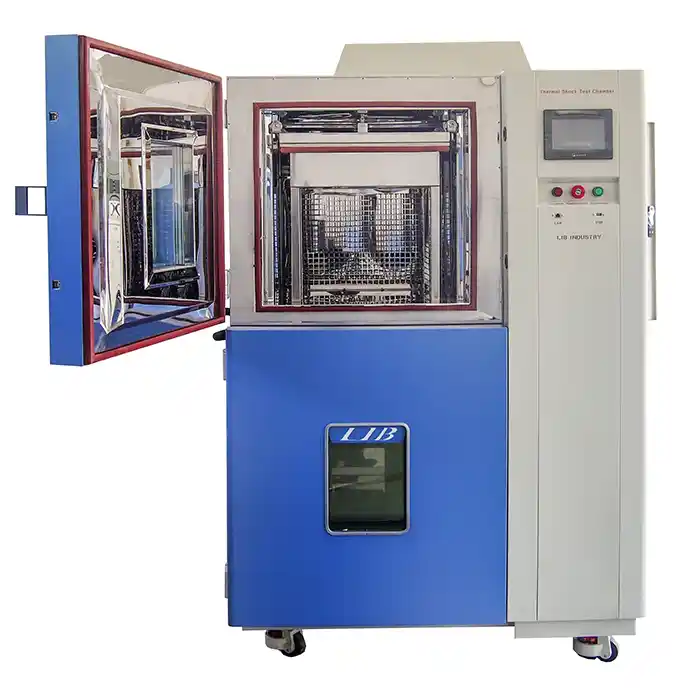
LIB thermal shock test equipment employ a dual-zone design with a dedicated hot compartment and cold compartment operating simultaneously. The specimen basket transfers vertically along precision rails, moving the test load from one zone to the other automatically. This eliminates the delay and temperature disturbance associated with manually moving specimens.
Refrigeration System and Compressor Technology
Achieving stable sub-zero temperatures down to -75°C requires a robust mechanical compression refrigeration system. LIB chambers use French TECUMSEH compressors paired with environmentally compliant refrigerants. The system maintains the cold chamber ready at the set point continuously, enabling consistent transition conditions regardless of when the basket transfer is triggered.
Controller and Programmability
A programmable color LCD touchscreen controller with Ethernet connectivity allows engineers to configure multi-step profiles with specified dwell times, transition triggers, and cycle counts. Data logging capability supports traceability requirements for ISO 9001 and IATF 16949 quality systems. Remote monitoring via Ethernet reduces operator intervention during extended multi-day tests.
Detecting Cracks, Delamination, and Structural Weak Points
The test chamber generates the stress; post-test analysis detects the damage. A structured inspection protocol transforms raw test specimens into actionable failure data.
Visual and Optical Microscopy Inspection
Surface cracks, coating spallation, and solder joint fractures are often visible under magnification between 20× and 200×. Systematic visual inspection of every solder joint and interface on a PCB assembly - combined with cross-sectional metallographic preparation - reveals crack initiation sites and propagation paths that correlate with stress-concentration predictions.
Electrical Continuity Monitoring
For electronic assemblies, in-situ or post-cycle resistance measurement detects opens and intermittents caused by fractured conductors or cracked solder joints. Daisy-chain test vehicles - PCB coupons designed specifically for reliability testing - allow resistance monitoring of hundreds of solder joints simultaneously during cycling without interrupting the test.
Non-Destructive Evaluation Techniques
Scanning acoustic microscopy (C-SAM) detects internal voids and delaminations invisible to optical inspection. X-ray computed tomography provides three-dimensional crack mapping in complex assemblies. These non-destructive methods preserve the specimen for subsequent mechanical or chemical analysis, maximizing the information extracted from each test run.
|
Inspection Method |
Detects |
Specimen Requirement |
|
Optical microscopy (cross-section) |
Solder fractures, micro-cracks |
Destructive - metallographic prep |
|
Scanning electron microscopy (SEM) |
Fracture surface morphology |
Destructive - conductive coating |
|
Electrical resistance monitoring |
Opens, intermittents in conductors |
Test vehicle with daisy-chain net |
|
Scanning acoustic microscopy (C-SAM) |
Internal voids, delaminations |
Non-destructive |
|
X-ray computed tomography (CT) |
3D crack mapping |
Non-destructive |
Failure Analysis and Reliability Evaluation After Thermal Shock Testing
Detecting failure is only the beginning. Translating physical damage observations into actionable reliability data requires a structured analysis framework connecting test conditions, failure modes, and design parameters.
Failure Mode and Effects Analysis (FMEA) Integration
Thermal shock test results feed directly into FMEA updates. When a solder joint fracture mode is confirmed in the chamber, the FMEA severity and occurrence ratings for that joint location are revised. This closed loop between physical testing and design documentation ensures that reliability predictions remain grounded in empirical data rather than theoretical assumptions.
Weibull Analysis for Service-Life Prediction
By testing multiple specimens to failure across defined cycle counts, engineers construct Weibull probability distributions that characterize the time-to-failure distribution of the population. The Weibull characteristic life (η) and shape parameter (β) quantify both the expected median life and the failure rate trend - critical inputs for warranty period decisions and accelerated life test modeling.
Accelerated Life Testing Correlation
Thermal shock chambers compress years of field exposure into days of laboratory cycling. Arrhenius and Coffin-Manson models translate accelerated cycle counts into equivalent field service hours under specific use-case temperature profiles. This correlation allows engineers to set pass/fail criteria that correspond to specific reliability targets, such as 0.1% failure rate at 10 years in service.
Dual-Zone Design for Faster Temperature Transition Rates - LIB Industry
|
|
|
|||||||||
|
Model |
TSI-038 |
|||||||||
|
Basket Useful Dimensions (mm) |
2400*1200*1300 D*W*H |
|||||||||
|
Salt Water Tank Dimensions (mm) |
3000*2000*1600 D*W*H |
|||||||||
|
Overall Dimension (mm) |
3600*2800*3800 D*W*H |
|||||||||
|
Loading Capacity |
200 kg |
|||||||||
|
Parameters |
Pre-heat Room |
Upper limit Temperature |
+220℃ |
|||||||
|
Heating Time |
Ambient ~ + 180℃, within 30 minutes |
|||||||||
|
Splash Water |
Splash Water Temperature |
0 to +4 ℃ (Adjustable) |
||||||||
|
Cycle Duration |
30 minutes |
|||||||||
|
Splash Nozzle |
Water Flow Rate |
3 to 4 liters per splash nozzle |
||||||||
| Number |
4 pieces |
|||||||||
|
Distance between nozzle and DUT |
300 to 350 mm |
|||||||||
|
Splashing Time |
3 seconds |
|||||||||
|
Number of cycles |
100 |
|||||||||
| Controller | Programmable color LCD touch screen controller | |||||||||
| Cooling system | Mechanical compression refrigeration system | |||||||||
| Exterior material | A3 Steel Plate with protective coating | |||||||||
| Viewing window | Interior lighting , double-layer thermo stability silicone rubber sealing | |||||||||


|
|
|
|
Test Basket |
The Controller |
|
|
|
|
Cable Hole |
Castor |


LIB Industry's thermal shock test chambers are engineered around a dual-zone architecture specifically optimized for industries where test throughput and transition precision are non-negotiable: aerospace qualification, automotive PPAP, consumer electronics accelerated life testing, and advanced materials research.
Simultaneous Zone Conditioning
Unlike single-chamber systems that heat and cool the same compartment sequentially, LIB's dual-zone design maintains both the hot and cold chambers at their set-point temperatures simultaneously. The specimen basket transfers between zones without any conditioning delay, delivering the maximum possible dT/dt (rate of temperature change) at the specimen surface - the key driver of thermal shock severity.
Safety and Protection Systems
LIB chambers incorporate multi-layer safety architecture: over-temperature protection, over-current protection, refrigerant high-pressure protection, and earth leakage protection. The observation window with double-layer thermally stable silicone rubber sealing allows visual monitoring without compromising chamber integrity. Interior lighting ensures specimens remain visible throughout the test.
Turn-Key Solution and Global Support
LIB Industry delivers a complete turn-key solution spanning research, design, production, commissioning, delivery, installation, and operator training. The standard configuration includes two shelves per chamber, cable access ports in 50mm, 100mm, and 200mm diameters for in-situ electrical monitoring, and SUS304 stainless steel interior for corrosion resistance and ease of decontamination.
Conclusion
Thermal shock testing remains one of the most direct and reproducible methods available for surfacing latent material failure risks before a product reaches service. By subjecting specimens to controlled, rapid temperature transitions within precisely calibrated chambers, engineers can quantify crack initiation thresholds, delamination susceptibility, and fatigue life with confidence. LIB Industry's thermal shock chambers - spanning 22 L to 505 L internal volumes - provide the temperature range, transition speed, and control precision required for global testing standards across aerospace, automotive, electronics, and materials science sectors.
FAQ
What is the difference between thermal shock testing and temperature cycling testing?
Thermal shock testing transfers specimens between hot and cold zones within a very short interval (typically under 5 minutes), imposing instantaneous thermal gradients across the part. Temperature cycling transitions the same zone slowly over 15–30 minutes, testing steady-state thermal fatigue rather than shock-induced stress. Each method targets distinct failure mechanisms.
How many cycles are required for a standard thermal shock test?
Cycle count depends on the applicable standard and product category. IEC 60068-2-14 test Nb commonly specifies 100–1000 cycles. Automotive standards such as AEC-Q100 and JEDEC JESD22-A104 define test durations based on product qualification grade. Your test engineer should derive cycle count from the intended use-case temperature profile and reliability target.
What industries benefit most from thermal shock chamber testing?
Aerospace (avionics, satellite components), automotive electronics (ECUs, sensors, battery packs), consumer electronics (smartphones, wearables), and advanced material science benefit most. Any product exposed to rapid ambient temperature changes during operation, storage, or transport - such as outdoor equipment or engine-bay components - requires thermal shock qualification.
Looking for a reliable thermal shock test chamber manufacturer, supplier, or factory? LIB Industry offers turn-key environmental testing solutions tailored to your specification. Contact our team at ellen@lib-industry.com to discuss your testing requirements.